At a glance
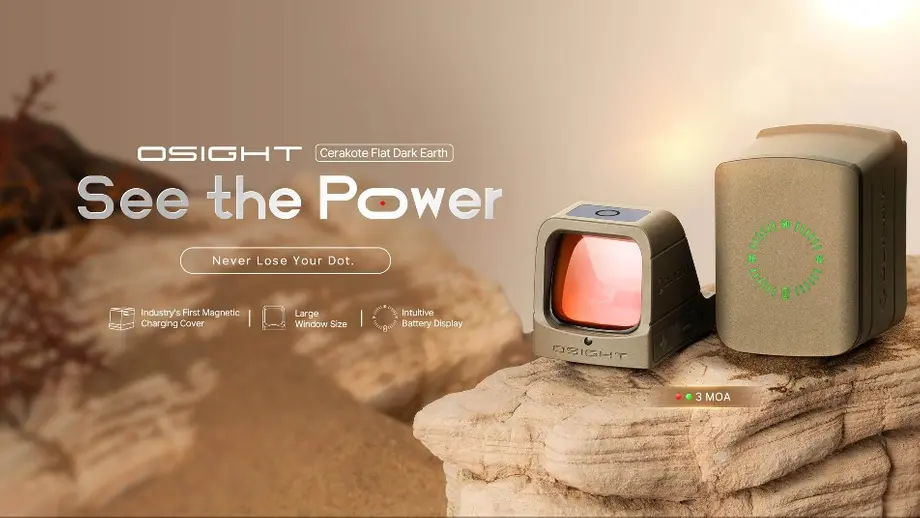
The Osight S pairs an enclosed OAL aluminium-alloy housing with a magnetic charging cover. Its red display can show a 2 MOA dot, a 32 MOA circle, or both. The original Osight 3 MOA has a larger window and a single dot. The Osight SE MOS shares the S’s window dimensions and uses a replaceable coin cell.
| Feature | Original Osight 3 MOA | Osight S | Osight SE MOS |
|---|---|---|---|
| Red display | Fixed 3 MOA dot | 2 MOA dot, 32 MOA circle or both | 2 MOA dot, 32 MOA circle or both |
| Published window | 24 × 21.5 mm | 21 × 14 mm | 21 × 14 mm |
| Emitter design | Open | Enclosed | Enclosed |
| Housing | 7075-T6 aluminium | OAL aluminium alloy | 7075-T6 aluminium |
| Power | Built-in rechargeable battery and magnetic charging cover | Built-in rechargeable battery and magnetic cover with USB-C input | Replaceable coin cell in a side tray |
What the 2 MOA dot and 32 MOA circle describe
MOA stands for minute of angle, or one sixtieth of a degree. It describes the apparent angular size of a shape in the display. On the Osight S, 2 MOA describes the dot and 32 MOA describes the diameter of the circle. The combined display shows a small central mark surrounded by the larger ring. The original Osight has a single 3 MOA dot, so its dot has an angular diameter 50% larger than the S dot.
The window dimensions are physical measurements in millimetres. The S has a window about 3 mm narrower and 7.5 mm shorter than the original Osight, based on the dimensions published for both models. Apparent clarity also depends on the lens, display brightness and how the viewer perceives the light.
Enclosed optics and OAL housing
The S puts the LED emitter inside a closed housing. The enclosure limits direct exposure of the emitter to lint and droplets, and the outer window surfaces remain accessible for cleaning. Osight also specifies an aspherical lens, which uses a non-spherical curvature to control distortion. Comparing transmission or distortion across models would require optical measurements across all three units.
OAL is Osight’s name for the aluminium alloy in the S housing. The original Osight and SE MOS use 7075-T6 aluminium. The S optic weighs 27.5 g, including its built-in battery. Its charging cover adds 33 g, bringing those two parts to 60.5 g together.
Olight rates the S optic IPX7 and the charging cover IPX4. Those are ratings for two separate parts. IPX7 denotes protection against temporary immersion under specified test conditions. IPX4 is a splash rating. The SE MOS housing is also rated IPX7 by Osight.
Magnetic charging and published battery life
The S has a 46 mAh built-in battery. Its 220 mAh cover takes power over USB-C and transfers it to the optic through the magnetic charging interface. The cover’s indicators show its own battery status and the optic’s battery status. That distinction makes it possible to see whether the optic has charge and whether the cover still has energy for another top-up.
Olight rates a full cover for up to three full recharges of the S and quotes 1.5 hours per recharge. Use that figure for the charge budget. The two capacities in mAh describe separate batteries, and transfers consume some of the energy stored by the cover.
The manufacturer lists up to 21,900 hours at brightness level 3 with the dot alone. The S also has light and motion sensors. Brightness, display pattern and how much time the unit spends active affect the useful interval between charges. The published figure belongs to the stated dot-only setting.
How the original Osight and SE MOS differ from the S
The original Osight 3 MOA also uses a magnetic charging cover. Its 24 × 21.5 mm window and single red dot distinguish it from the smaller-window S. The two product listings specify charging covers for their respective models. Check the model name on the cover before replacing a lost one.
The Osight SE MOS shares the S’s 21 × 14 mm window size and the same three red display options. Its housing is 7075-T6 aluminium. The important difference for day-to-day upkeep is the power source. The SE MOS takes a replaceable coin cell in a side tray, while the S draws on an internal rechargeable battery and its cover. Use the battery code printed in the documentation for the exact SE MOS variant.
The three models therefore differ most in the combination of display and upkeep. The original pairs the bigger physical window with a fixed dot. The S pairs an enclosed emitter and three display options with a rechargeable cover. The SE MOS shares the enclosed design and display options, with a replaceable battery.
Frequently asked questions
Does the Osight S always show the circle?
The red display has three configurations. It can show the 2 MOA dot alone, the 32 MOA circle alone, or both at once.
Can the Osight S charging cover get wet?
Olight rates the charging cover IPX4 for splashes and the optic IPX7 under a separate immersion test. Dry the parts and charging contacts before connecting power.
Do the Osight S and SE MOS have the same battery system?
The S has an internal rechargeable cell and a magnetic charging cover. The SE MOS takes a replaceable coin cell in a side tray. Both have an enclosed emitter and the same published window dimensions.